

Sweet J
Free Karplus Equation Calculator for NMR
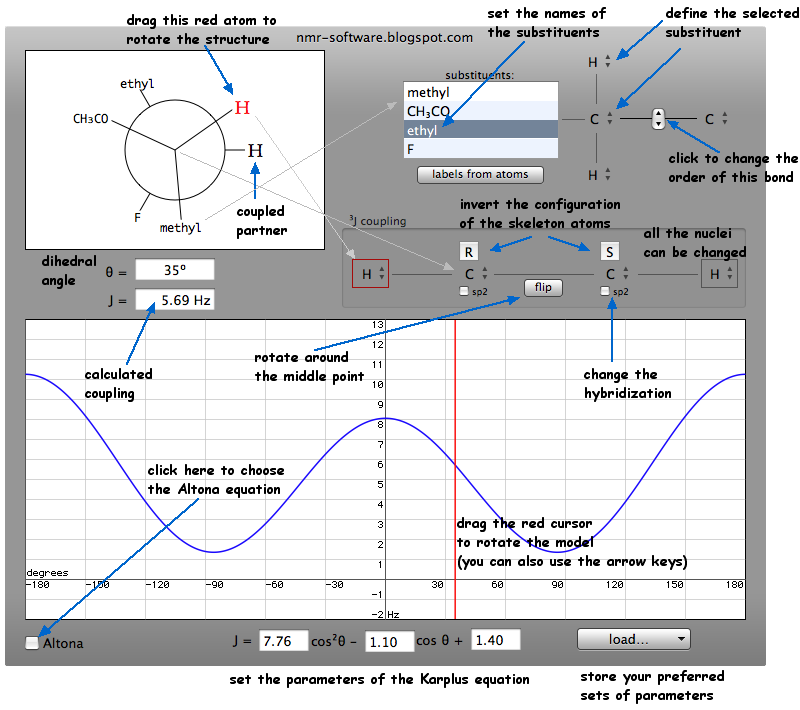
Sweet J computes the vicinal 3J coupling constant from the dihedral angle and the electronegativity of the substituents, using either the Altona equation or a generalized Karplus equation. It is the standard desktop tool for dihedral angle analysis and NMR conformation studies.
Sweet J is free to download and use. It is part of the iNMR ecosystem for NMR processing and analysis.
Watch Sweet J in action on YouTube
| Latest version: | 2.5 |
| Released: | April 23, 2026 |
| What’s new: | Recompiled for Apple Silicon; now available on the Mac App Store |
Downloads
- Sweet J 2.5 on the Mac App Store (recommended — Apple Silicon and Intel)
- Sweet J 2.3 (requires Mac OS 10.5 or later)
- Source code
How it works
The Karplus equation relates the vicinal proton-proton coupling constant 3JHH to the H‑C‑C‑H dihedral angle φ. Sweet J extends this to the Altona generalization, which accounts for the electronegativity and orientation of substituents on both carbons, making it applicable to a broad range of molecular conformations.
When two residues on the same center are identical but carry different labels, Sweet J treats that center as chiral. The two residues receive higher CIP priority than the remaining substituents; their relative priority follows alphabetical order (case-sensitive).
Links
Empirical parameters for the Karplus equation (hetero- and homonuclear 3J)
A comprehensive collection of special-purpose Karplus equations with parameters,
plots, applications and primary references.
References
Giuseppe Balacco
A Desktop Calculator for the Karplus Equation
J. Chem. Inf. Comput. Sci., 1996, 36 (4), pp 885–887
DOI: 10.1021/ci950227r
C.A.G. Haasnoot, F.A.A.M. DeLeeuw and C. Altona
The relationship between proton-proton NMR coupling constants
and substituent electronegativities — I:
An empirical generalization of the Karplus equation
Tetrahedron, 1980, 36, pp 2783–2792
DOI: 10.1016/0040-4020(80)80155-4
Martin Karplus
Vicinal Proton Coupling in Nuclear Magnetic Resonance
J. Am. Chem. Soc., 1963, 85 (18), pp 2870–2871
DOI: 10.1021/ja00901a059